

By Ayur wakeup | May 16, 2026
The burning. The constant urge to go, even when nothing comes. Anyone who has had a UTI knows how quickly it shuts down the rest of your day. And when it keeps coming back three, four times a year, something in the standard approach is clearly not solving the real problem. Ayurvedic medicine for UTI starts from a different place than conventional treatment. Not “what bacteria is doing this,” but “why does this keep happening here.” That one shift changes what the treatment actually looks like.
How Does Ayurvedic Medicine for UTI Work?
Ayurveda gives this condition a name: Mutrakrichra. Roughly translated, it means difficult or painful urination. But the diagnosis goes well beyond labelling symptoms.
According to Ayurvedic clinical assessment, the underlying cause in most UTI cases is a buildup of Pitta dosha within the Mutravaha Srotas, the urinary channels. Pitta governs heat and inflammatory processes in the body. When it accumulates in the urinary tract, the tissue lining gets irritated, urine turns acidic, and the mucous membrane loses the protective quality it normally maintains. Bacteria settle easily in that kind of environment.
So the treatment isn’t “destroying what is currently in the tract.” It is “restore the tissue so infection stops finding a home there.” That is the part antibiotics do not address, and that gap is where Ayurveda has something concrete to offer.
Herbs Used in Clinical Practice
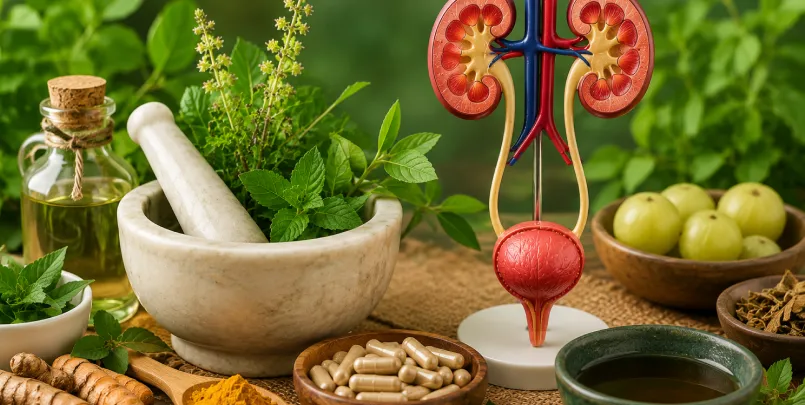
Gokshura (Tribulus terrestris) comes up most consistently for urinary conditions. It increases urine output and flushes the tract without stripping the tissue lining. Punarnava targets inflammation in the kidney and bladder specifically. Varuna bark has been part of Ayurvedic urinary protocols for generations, used for recurrent infections and early obstruction.
Chandraprabha Vati is a compound formula. It covers inflammation, tissue weakness, and infection susceptibility together rather than targeting just one aspect. It gets prescribed after proper assessment, not picked up as a general supplement.
Which of these applies? That depends on your constitution, the severity of the condition, and what the full clinical picture shows. A qualified Ayurvedic physician makes that determination after diagnosis, not before.
Diet Is Part of the Prescription
Spicy, acidic, fermented foods keep Pitta elevated even when herbs are doing their work. Those dietary habits keep feeding the problem underneath.
During treatment, Ayurvedic physicians typically recommend cooling fluids: coconut water, coriander seed water, and barley water. Foods like cucumber and buttermilk reduce urine acidity and calm the inflamed tissue lining. Not complicated changes. But they have to be consistent.
Why Do Some People Keep Getting UTIs All Year?
Three infections in twelve months is a pattern, not bad luck. Antibiotics clear each one cleanly. But if the vulnerability stays, so does the cycle.
Ayurvedic treatment in Kerala, particularly at centers with dedicated women’s health programs, treats recurring urinary and reproductive infections as a connected pattern rather than separate events. At Ayur Wakeup, the ayurvedic treatment for gynecological disorders program covers conditions like leukorrhea and recurrent vaginal infections, both of which often share the same root Pitta imbalance as recurring UTIs.
The clinical assessment looks at digestive strength (Agni), tissue nourishment through Dhatu balance, hormonal regulation, and nervous system health together. A recurring UTI, in this view, is usually not just a bacterial problem. It is a sign that something systemic needs attention.
Uttara Basti: What It Is
Uttara Basti is a Panchakarma procedure where medicated oils or herbal decoctions are introduced directly into the urinary or reproductive tract. It is used clinically for lower urinary tract conditions and recurrent infections when indicated.
Not a home remedy. Not a wellness session. It is administered by a qualified physician after full Prakriti assessment. At Ayur Wakeup, under Dr Arun Radhesh R (B.A.M.S., MBA), this forms part of a structured clinical program, not a standalone appointment.
Does Ayurveda Replace Antibiotics for UTI?
No, and a qualified Ayurvedic doctor will tell you the same.
For an active infection with fever, back pain near the kidneys, or blood in urine, antibiotics are medically necessary. Waiting to try herbs first risks a bladder infection moving to the kidneys. A fever above 38.5°C, symptoms getting worse after 48 hours, blood in urine: any of those means seeing a doctor that day, not browsing remedies.
Ayurvedic medicine for UTI is most useful in three situations: as supportive care running alongside antibiotic treatment, as a recovery protocol after the infection clears, and as a long-term approach to breaking the recurring pattern.
Final Thoughts
One UTI handled with antibiotics is routine. Four in a year is a different conversation entirely. Ayurveda looks at the tissue environment, dietary habits, Pitta buildup, and immune function that shape how the urinary tract holds up over time. It fills the gap conventional treatment leaves wide open.
If the infections keep coming back, the pattern itself is what needs addressing. Speaking with a qualified Ayurvedic physician is the practical first step.
Has your UTI history always been managed with antibiotics alone, or have you looked at what might be driving the pattern?
FAQ
Can Ayurvedic medicine treat a UTI without antibiotics?
For an active infection with fever or worsening symptoms, antibiotics are the right call. Ayurveda is most useful alongside treatment and for preventing recurrence. Do not delay antibiotic care to try herbs first.
What herbs does Ayurveda use for UTIs?
Gokshura, Punarnava, Varuna bark, and Chandraprabha Vati are the most common in clinical practice. Each works differently. A physician determines which combination fits your case after proper assessment.
Why do I keep getting UTIs?
Recurring infections usually point to persistent Pitta aggravation and weakened tissue immunity in the urinary tract. Diet is often a big part of the problem. Ayurveda addresses the pattern rather than just each individual infection.
Do Is Ayurvedic treatment safe to take with antibiotics?
Usually yes, but only under physician supervision. Some herbal formulations can interact with medications. A qualified doctor designs a protocol that works alongside what you are already taking.
How long does Ayurvedic treatment for UTI take?
Active discomfort can ease within days. Breaking a recurring pattern typically takes 4 to 8 weeks of consistent treatment. Chronic imbalances do not reverse quickly.