

By Ayur wakeup | September 17, 2026
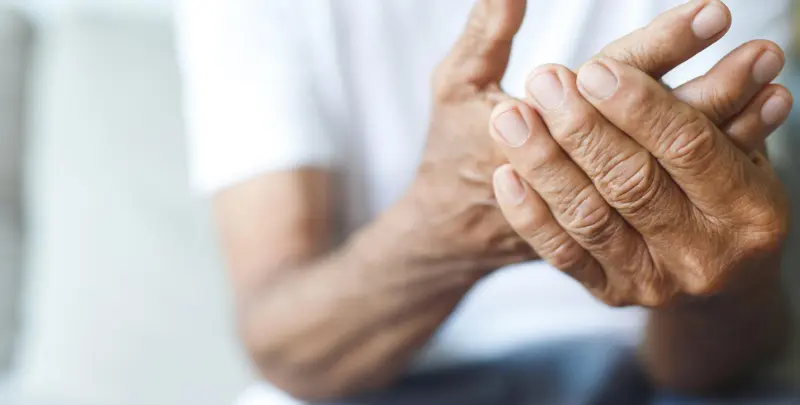
A stiff, swollen knuckle can be one of the early signs of rheumatoid arthritis, particularly when morning stiffness and swelling persist or recur. But when rheumatoid arthritis in hands is behind it, that same knuckle is often the first signal the body gives, sometimes weeks before anything else feels off. Ayurveda has tracked this pattern for a long time and built its own explanation around it, one that starts at the fingers and toes rather than the hips or spine.
Rheumatoid Arthritis in Hands: Why Small Joints React First
From an Ayurvedic perspective, Amavata is understood through the interaction of ama and aggravated Vata. Classical Ayurvedic descriptions interpret joint symptoms through this framework. But the modern biomedical explanation of rheumatoid arthritis involves autoimmune inflammation affecting the synovial joints. When ama builds up and vata becomes aggravated, the smaller, more mobile joints tend to show early rheumatoid arthritis symptoms before the disturbance reaches larger joints like the knees.
Kerala’s protocol treats this as a moving pattern rather than a fixed one. Pain that shifts from one finger to another, or from a wrist to an ankle, is read as a sign that vata instability is still active instead of settling in one place.
Five Clinical Signs Ayurveda Doctors Check For
Morning stiffness that eases with movement is called Sthambha, and it usually points to ama sitting inside the joint capsule itself. Migrating pain, jumping between joints rather than staying fixed, signals vata instability and calls for warm, oil-based therapy instead of dry treatments.
Visible swelling, or shopha, means the synovial membrane has become inflamed. At this stage, physicians often use a continuous pour of warm medicinal liquid rather than oils, since oil can sometimes aggravate active swelling.
Karmahani describes a loss of function, when a joint can no longer bend fully or manage daily tasks. It marks depleted tissue that needs rebuilding rather than just calming down. Vrischika Damsha is a sharp, burning pain that behaves more like active inflammation than mechanical wear, and it typically needs cooling treatment before detox work begins.
BAMS physicians trained in texts such as the Madhava Nidana use these five signs, called Lakshanas, alongside pulse diagnosis and a check of digestive Agni to work out how far a case has progressed. Ayurvedic treatment for rheumatoid arthritis in Kerala also reviews ESR, CRP, and rheumatoid factor lab reports, so the picture isn’t based on pulse alone.
How Kerala’s Three-Step Protocol Responds to Small-Joint Involvement
Amavata Ayurveda treatment in Kerala generally follows three stages instead of one fixed prescription. The first, Deepana and Pachana, focuses on correcting digestion with herbs such as guggulu, since poor agni is treated as the starting point of ama formation. The second stage is Panchakarma detoxification itself. Virechana clears toxins through the gut, and Basti, a form of medicated enema, is used to settle vata through the nervous system. ESR, CRP, and rheumatoid factor lab markers would help readers unfamiliar with these terms, since Kerala physicians track them alongside pulse diagnosis to measure progress objectively.
The final stage, Rasayana, is aimed specifically at rebuilding small joints. Njavarakizhi, a warm poultice made from a medicated rice preparation, is used to strengthen muscles and ligaments around depleted joints. Janu Basti, a reservoir of warm medicated oil held over the knee, is used more often for larger joint involvement. Most residential stays run 14 to 21 days. The shorter course covers oleation and early detox, and the longer one adds extended rejuvenation for cases that have been active for a while.
Diet and Daily Habits That Support the Fingers and Toes
Diet plays a large role in how quickly joint stiffness in fingers settles during a course of care, at least by the Ayurvedic view. Kerala’s protocol generally avoids curd, fermented foods, cold beverages, and nightshades like tomatoes and potatoes, since these are considered to aggravate both ama and vata. In their place, physicians often recommend warm barley water, red rice, drumstick leaves, and a ginger-turmeric infusion, foods thought to support digestion without adding further metabolic load.
None of this replaces prescribed internal medicine. Formulations such as Guggulu-based preparations, Shunthi, Rasna, or Triphala are dosed individually by a physician, not picked up off a shelf. What a patient eats between therapy sessions, though, is treated as part of the same plan rather than a side note tacked on at the end.
Final Thoughts
Rheumatoid arthritis in hands rarely announces itself loudly. It tends to arrive quietly, in a knuckle that takes a little longer to loosen each morning, and Ayurveda has spent a long time studying exactly that pattern instead of waiting for pain to reach the larger joints. Understanding why the smaller joints react first, whether through the Ayurvedic lens of ama and vata or just by watching your own hands over a few weeks, is often the difference between catching something early and managing it once it has settled in. If your fingers have felt stiffer than usual lately, what do you notice first: the stiffness itself, or how long it takes to fade?
FAQ
Why do my fingers hurt before my knees or hips do?
Ayurveda ties this to Amavata, where ama and aggravated vata settle in the body’s finer channels first, and those channels are more concentrated in the fingers, wrists, and toes. Larger joints tend to get involved later, once the imbalance has been active for a while, which is why hands are often the first place people notice something off.
Is morning stiffness in the hands always a warning sign?
Not always, but stiffness lasting more than thirty minutes that returns daily is worth paying attention to. In Ayurvedic terms this is Sthambha, one of five key signs physicians look for when assessing Amavata, alongside swelling, migrating pain, and loss of function.
Can diet actually change how my joints feel day to day?
Kerala physicians treat diet as half the treatment, not a side note. Avoiding curd, cold drinks, and nightshades while adding warm barley water or a ginger-turmeric infusion is meant to reduce the metabolic load Ayurveda links to ama building up in the joints.
How long does a Panchakarma program for arthritis usually run?
Most residential protocols last 14 to 21 days. The shorter course covers internal oleation and initial detox, while the longer one adds an extended rejuvenation phase aimed at rebuilding tissue around joints affected for some time.
Do I need to stop my regular arthritis medication for this?
No responsible Ayurvedic program asks you to stop prescribed medication on your own. Physicians typically work alongside a patient’s existing treatment and adjust it gradually, only when clinical signs support doing so, always in coordination with the prescribing doctor.